Master of Education
Master's in Education
1 year (2 regular periods and 1 extraordinary period)
Credits:30
Híbrida
$7.500
Enrollment: $681
Tuition: $6.819
Monday to Thursday from 6:00 PM to 8:30 PM (synchronous virtual); and Saturdays from 9:00 AM to 1:00 PM (in-person, 2 meetings per month)
August, 2026
August 2025 to June 2026 (subject to available spots)
College of Social Sciences and Humanities
RPC-SO-41-No.682-2024, October 9, 2024
Campus Santiago Gangotena
Teach with vocation and leave your mark on education
The USFQ Master's in Education strengthens your pedagogical training with a solid foundation in learning planning and assessment. It prepares you to teach with rigor in a constantly changing educational environment, shaped by technology and artificial intelligence.
You develop your teaching practice with judgment, innovation, and a human sense of purpose.

Program Objective
You build a strategic vision of the territory, develop tools for planning and decision-making, and strengthen your capacities to design sustainable, inclusive, and contextualized solutions.
You develop foundations in governance, planning, and territorial development; incorporate technical, legal, and technological tools; and apply what you have learned in real contexts. Throughout the program, you strengthen your ability to analyze complex scenarios, coordinate stakeholders, and propose strategies that generate impact in the territories.

Applicant and Graduate Profile
Who is this master's degree aimed at?
Professionals with an undergraduate degree interested in planning, public management, decision-making, and territorial development.
Profiles related to Political Science are prioritized, although professionals from other fields who can demonstrate at least one year of relevant experience may also apply.
Degrees obtained abroad must be submitted apostilled or legalized in accordance with current regulations.
What will your professional outlook be?
Upon graduation, you will be able to design and implement sustainable development strategies, planning, and territorial management, integrating technical tools and strategic criteria for decision-making.
You will be able to work in:
- Ministries and public entities.
- Decentralized Autonomous Governments (GAD).
- Oversight bodies.
- NGOs and foundations.
- International organizations.
- Companies that work with the State.
- Consulting and territorial development projects.
Liberal Arts to Transform Learning
The Liberal Arts approach broadens your educational perspective by integrating psychology, ethics, communication, technology, and society. This approach strengthens your judgment to design educational experiences and develop a critical stance toward the changes affecting education: globalization, inclusion, and technological transformation.
You develop critical thinking to analyze how people learn, make informed pedagogical decisions, and lead educational processes with social commitment.
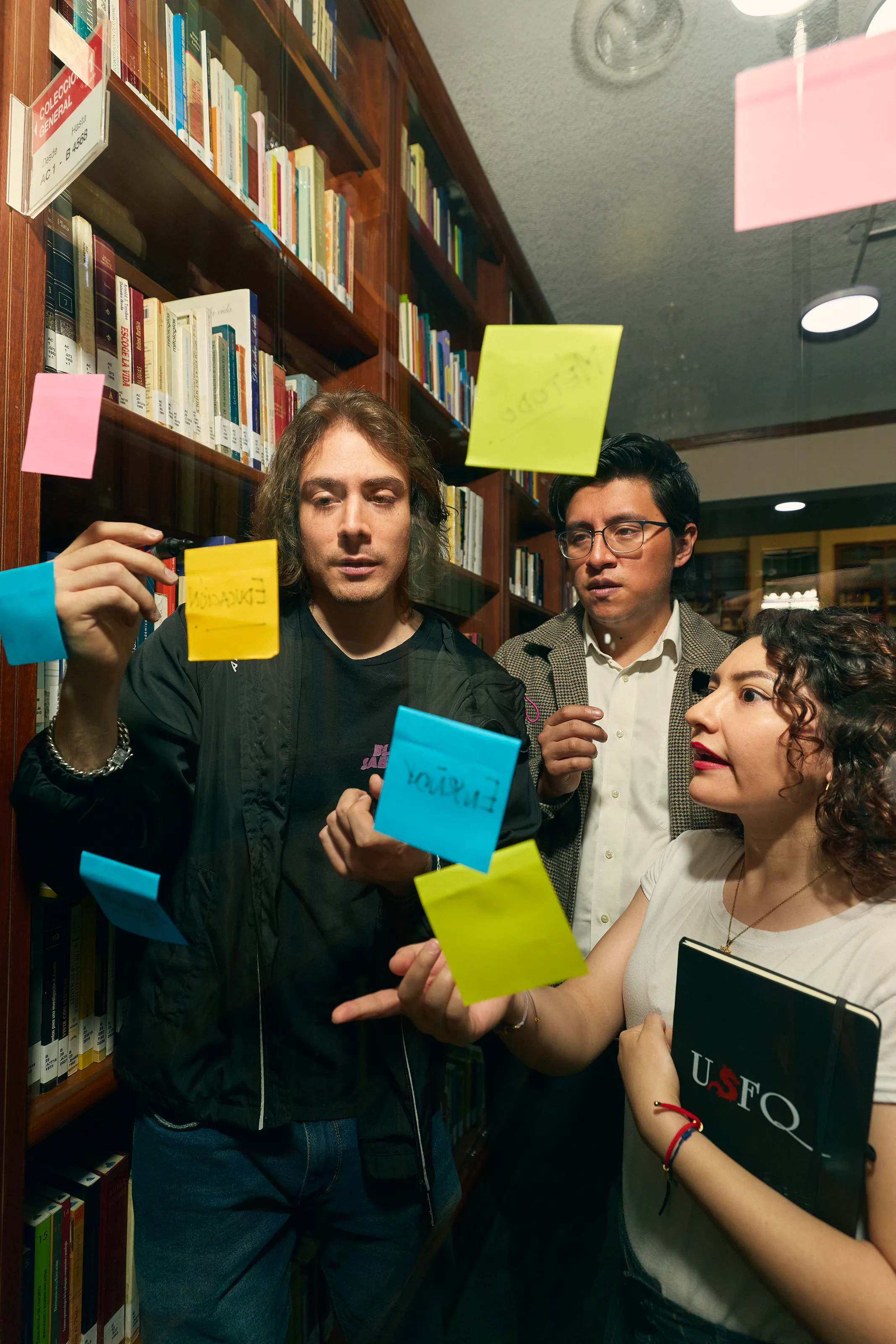
Spaces that drive new forms of teaching
The master's program connects your training with different educational settings. You learn to integrate educational technology, advanced pedagogical strategies, and inclusive practices that promote diversity, equity, and learning for all students.
Includes
- Educational institutions.
- Teacher training.
- Community projects.
- Educational management and innovation.