Master's in Nanoelectronics
- Master's in Nanoelectronics, Concentration in Embedded Systems and Integration
- Master's in Nanoelectronics, Concentration in Characterization, Modeling and Design
2 years (4 regular terms and 1 extraordinary term)
1st year: USFQ – Ecuador
2nd year: INPT Toulousse – France / UNICAL – Italy
60
In-person
$10.397
Enrollment: $926
Tuition: $9.471
Full time
August, 2027
August 2026 to June 2027 (subject to available spots)
College of Sciences and Engineering (Polytechnic)
RPC-SO-31-No.712-2021, November 17, 2021
Campus Santiago Gangotena
Explore technology at a new scale
The Master's in Nanoelectronics at USFQ invites you to design increasingly smaller, faster, and smarter technologies. You will understand the evolution of electronics, from solid state to nanoscale devices, in a context where Moore's Law gives way to the "More than Moore" approach.
The program integrates materials physics, micro and nanoelectronic devices, analog and digital integrated circuit design with industrial-level EDA (Electronic Design Automation) tools.
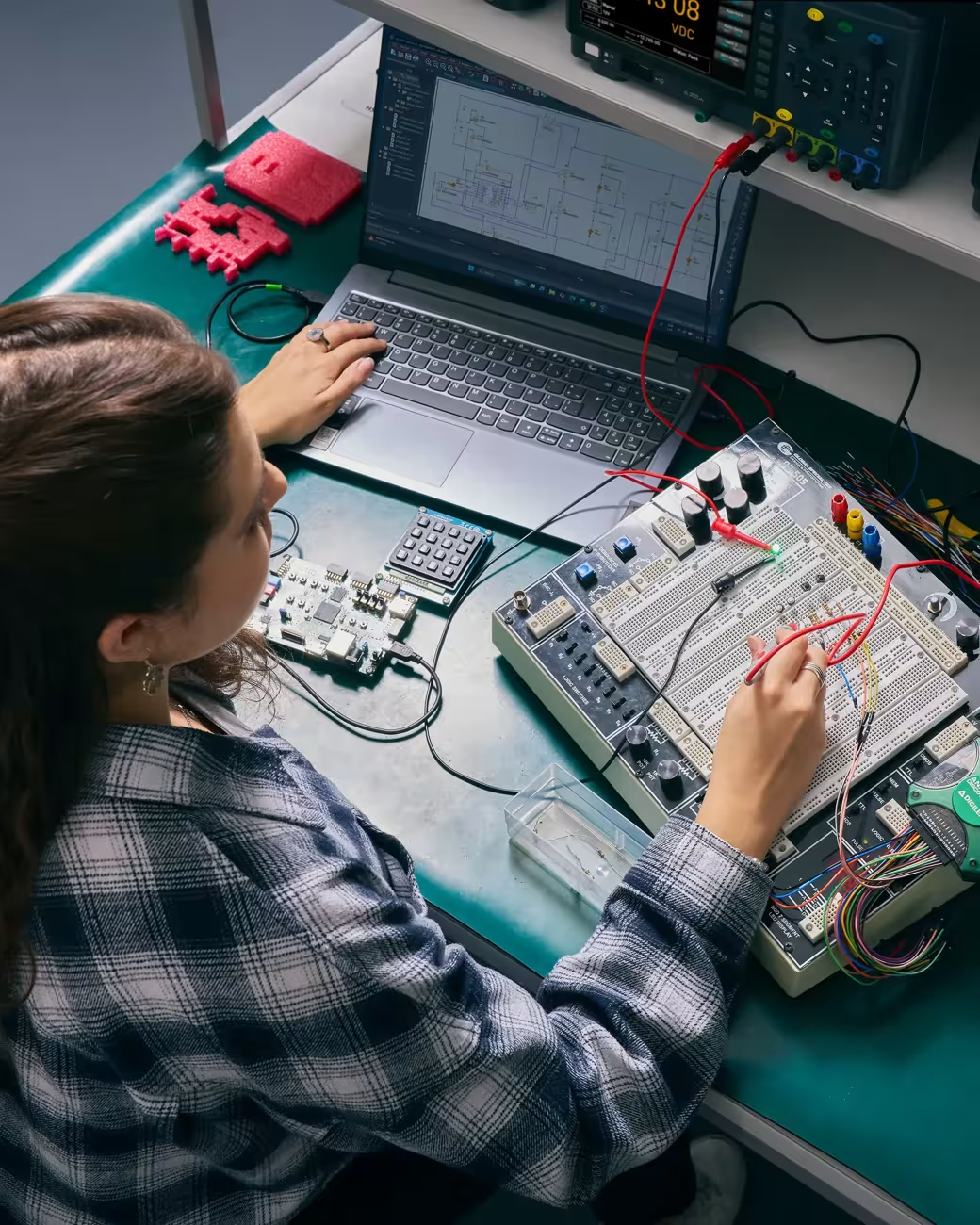
Program Objective
During the master's program, you understand, design, and develop electronic technologies at the nanometric level through the integration of advanced physics, engineering, and circuit design.
Through rigorous training and the use of industrial electronic design tools, you prepare yourself to create innovative solutions and lead research and development projects in nanoelectronics.
Download the Master's in Nanoelectronics catalog
Academic Curriculum M. Nanoelectronics, Specialization in Characterization, Modeling and Conception


Applicant and Graduate Profile
Who is this master's degree aimed at?
At professionals in engineering, physics, materials, electronics, or related fields who seek to deepen their knowledge in emerging technologies and advanced applications.
What will your professional outlook be?
You will become a professional capable of integrating into the global technology industry, participating in the development of micro and nanochips and advanced systems. You will be able to innovate in leading companies in the sector and contribute high-impact solutions.
You will also be able to project yourself toward frontier research, continue doctoral studies at internationally prestigious universities, and become a benchmark for scientific and technological development in Ecuador and the world.
Liberal Arts that empower the engineering of the future
The Liberal Arts approach expands your ability to think about complex systems from a technical, ethical, and human perspective.
You learn to communicate high-level ideas with clarity, lead multidisciplinary teams, analyze the social impact of technology, and place innovation in scientific, economic, and global contexts that demand judgment, strategic vision, and responsibility.
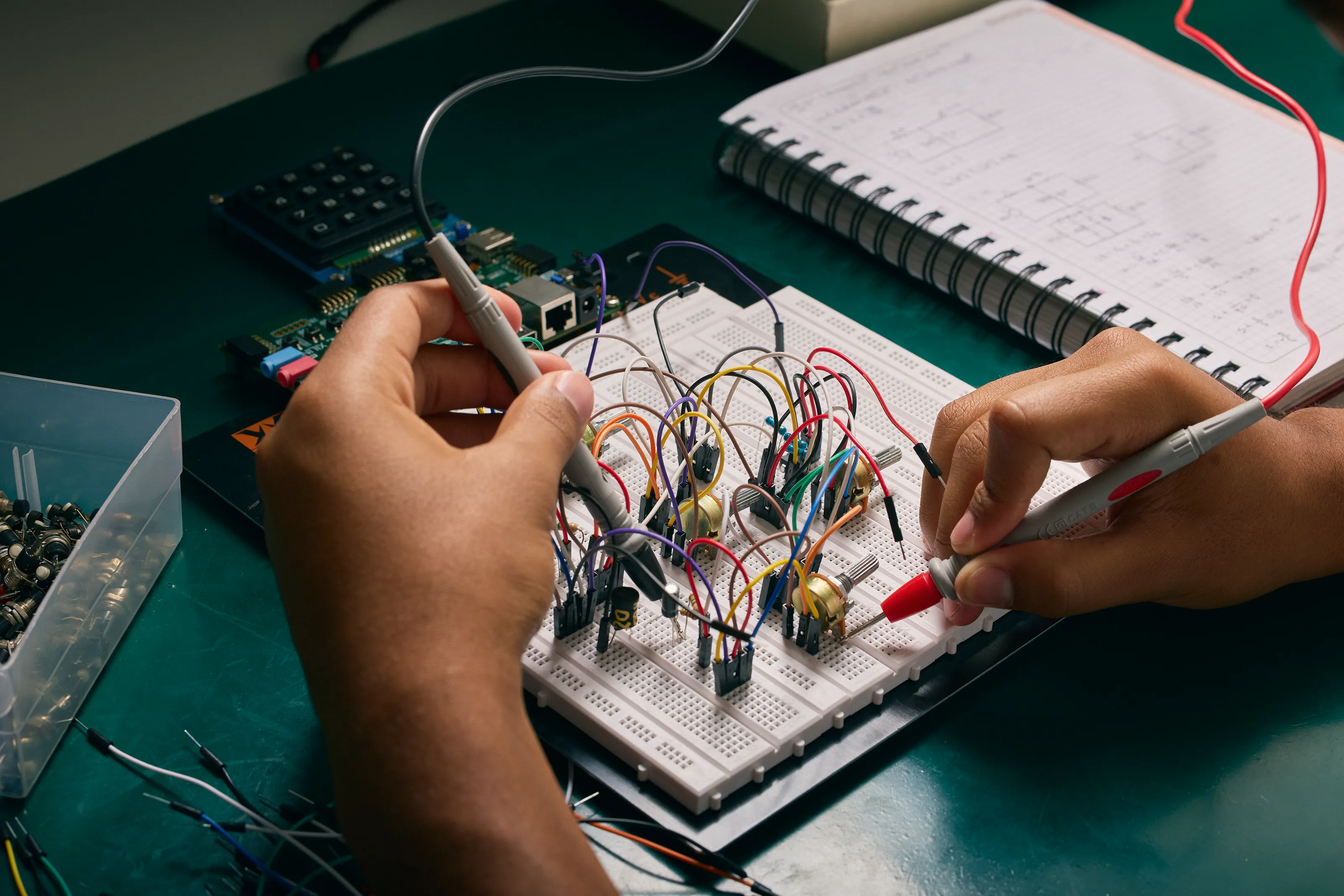
Innovation and interdisciplinary projects
You have access to spaces equipped for research in electronic devices and integrated circuits.
Includes
- Electrical characterization laboratories for silicon wafers.
- EDA Software incorporated in design and simulation classes: Synopsys, Cadence Design Systems, and Siemens EDA.
- Electronic device simulation and design laboratory.
- Integrated circuit design laboratory with full-custom and top-down methodologies.
- High-frequency laboratory.
- Optoelectronics laboratory.
Additionally, you can complete your second year at the Institut National Polytechnique de Toulouse in France or at the University of Calabria in Italy.