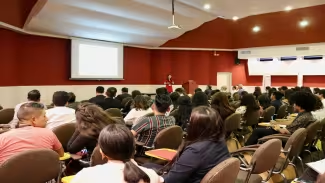
Annual Congress of Meteorology and Air Quality (CAMCA 2019)
- Schedule
- 8:00 am - 5:00 pm
- Venue
- Teatro Casa Blanca, USFQ Campus Cumbayá
Speaker Guidelines
Guidelines for paper presentations
Authors will be contacted in due course by email regarding their presentation time.
Please follow the guidelines described below to present your work.
Talk session:
- The duration of the talks will be communicated in due course and time will be allotted for questions. Please prepare a presentation that does not exceed the established time.
- Bring the presentation file on a flash drive and load it before your session begins.
- On the day assigned for your presentation, go to Teatro Casa Blanca with your file to load it during the following schedule:
Morning talks: from 08h00 to 08h30
Afternoon talks: from 12h00 to 13h00
- Bring files in Power Point format or converted to PDF.
- Mac or Linux Users? It is best to convert your file to PDF, in order to avoid formatting issues during the presentation.
Poster session from 15h45 to 17h00 - Teatro Casa Blanca USFQ:
- The maximum acceptable size for posters is A0 and they must be printed vertically.
- Below the title, include the names of the authors, professional affiliations and a contact email.
- Make sure to use an appropriate font size for the text and present graphics with legible scales.
- A number will be assigned to each poster; look for your assigned easel with its corresponding number.
- Authors must hang their posters in the designated spaces well before the session begins; that is, from 08h00 and no later than 12h30 on April 26.
- All authors must be next to their posters presenting them to the public from 15h45 to 17h00.
- The CAMCA Honor Judges will be visiting them at their assigned location.
Direct questions to:
María del Carmen Cazorla
mcazorla@usfq.edu.ec
Special conferences
AERONET—1 to 600 in 25 years
Brent Holben
Physical Scientist
AERONET Principal Investigator
Brent Holben has worked at NASA's GSFC for over 38 years performing research in both ground-based and satellite remote sensing of landcover and aerosols. Additionally he has developed innovative methods for in-orbit calibration of satellite visible and near-IR sensors. He is the project leader for the global AERONET sun-sky radiometer network that is providing spectral aerosol optical depth and microphysical and radiometric properties for NASA's satellite cal/val program as well as validation for a variety of US and foreign satellite systems and aerosol model programs. In the process of developing the network and characterizing the great variety of aerosol types and processes, Mr. Holben and his team have led or participated in numerous airborne, ground-based and satellite field campaigns and that emphasize research and validation. These measurement campaigns have led to numerous collaborations in Brazil, Southern Africa, West Africa, US, Canada, Europe, UAE, India, Korea, Japan and SE Asia. This process of research through field campaigns requires collaboration and federation with NASA and non NASA partners encouraging the network to expand to more than 500 globally distributed measurement sites. Under Holben's 23 year guidance, AERONET has become a global-standard for aerosol research and validation of satellite, airborne RS and model datasets and in situ comparisons and model assimilation. Of particular importance, Holben through AERONET, initiated NASA's first fully open public domain research database that is accessible in near real time. Holben has received several awards most notably Goddard's highest award for contributions to environmental science, the William Nordberg Memorial award in 2005 and became an AGU Fellow in 2016.
Improvements to Aerosol Robotic Network (AERONET) Data Products for Near Real-time Applications
Dr. David M. Giles
AERONET Project Scientist
Dr. David Giles graduated from Pennsylvania State University (PSU) in 1997, with a B.S. in Meteorology. In 2001, Dr. Giles joined the Aerosol Robotic Network (AERONET) project at the NASA Goddard Space Flight Center in Greenbelt, MD. In 2003, he simultaneously continued his education at the University of Maryland-College Park (UMCP), earning an M.S. in 2006 and Ph.D. in 2012 in Atmospheric and Oceanic Science. He has continued to provide computer programming, database and web development, and scientific analysis support for the NASA AERONET project for more than 17 years. Dr. Giles has provided support in AERONET direct sun, lunar, and sky measurement algorithm development and quality assurance, authored and co-authored peer-reviewed manuscripts, and participated in field campaign missions.
Ultraviolet Radiation Index in Quito during solar noon: Records versus levels obtained from satellite images
Dr. René Parra
Director of the Volcanic Ash Research Group in Ecuador GICVE USFQ
Doctor in Environmental Engineering from the Universitat Politѐcnica de Catalunya. Extraordinary Doctorate Award in the field of Environmental Engineering and Sustainability 2003-2004. Faculty and Researcher at USFQ. Member of the Volcanic Ash Research Group in Ecuador (GICVE). Research areas: air pollution, atmospheric emissions inventories, pollutant and volcanic ash dispersion.
Fingerprint of the quasi-biennial oscillation (QBO) in the first ECHOZ (Ecuadorian Highlands Ozonesondes) series from the EMA USFQ
María del Carmen Cazorla, PhD
Director of the Atmospheric Research Institute IIA USFQ
She completed a Postdoctoral fellowship at NASA (Goddard Space Flight Center, USA) developing an induced fluorescence sensor to detect formaldehyde in the upper troposphere and lower stratosphere (2010-2012). She obtained her PhD in Meteorology from Penn State University (2010). She won the Peter B. Wagner Memorial Award for Women in Atmospheric Sciences (2010) awarded by the Desert Research Institute (DRI). She holds an MSc in Environmental Pollution Control from Penn State University, as a Fulbright scholar (2003-2005). In 2018, her ECHOZ proposal was funded by the United Nations Ozone Secretariat to contribute to ozone layer monitoring over the equatorial Andes. Professor and researcher at USFQ since 2012, she is the founder and director of the Atmospheric Research Institute (IIA) and the Atmospheric Measurement Station (EMA) at USFQ. Her research interests include atmospheric physics, pollution chemistry, and instrument development.
Abstracts
Registration and deadlines
Attendees with paper
Registration until April 15
If you wish to present your work in talk or poster format, send your document (abstract) in Word format to ema@usfq.edu.ec with title, authors, professional or academic affiliations, abstract text (max 400 words), presenting author's email and keywords.
The scientific committee will contact you regarding the format of your presentation.
Attendees without paper
Registration until April 24
Professionals: $70
USFQ Professionals: $49
Students from all institutions: $40 (upon presentation of student ID)
*Includes organization, materials, certificate, coffee breaks and lunch
Send an email with your details and proof of payment to: ema@usfq.edu.ec
Banco Bolivariano
Checking Account 1645003014
USFQ RUC: 1791836154001
For international attendees, we have lodging suggestions near USFQ. If you would like more information about this, please request it by email at ema@usfq.edu.ec