
Philosophy of Liberal Arts
The impact of a Liberal Arts education
When Universidad San Francisco de Quito USFQ was born in the late eighties, university education in Ecuador was focused on training specialists. USFQ was born with a different vision: to form people capable of thinking for themselves, questioning, creating and imagining their own path.
Inspired by the Liberal Arts tradition, USFQ recovered an essential idea: the university should not limit itself to teaching a profession, but prepare each person to answer a more complex question: how to live a full, free and purposeful life?
At USFQ, areas of knowledge dialogue with each other through a diverse academic offering that integrates minors, General College courses and research projects that allow us to broaden the way we understand the world and our place in it.
USFQ does not only train professionals. It forms free human beings.
Not everyone arrives at university certain about what they want to study. The most important question is usually a different one: how do I want to contribute to the world? That answer rarely appears within a single discipline, nor does it come immediately. It requires curiosity, trial and error.
Liberal Arts starts from a conviction: education does not consist of accumulating answers; it seeks to formulate better questions. No one discovers who they are by following a single path. Exploring, making mistakes, changing direction and discovering new possibilities are all part of an education that seeks to transform the world.
A legacy for life
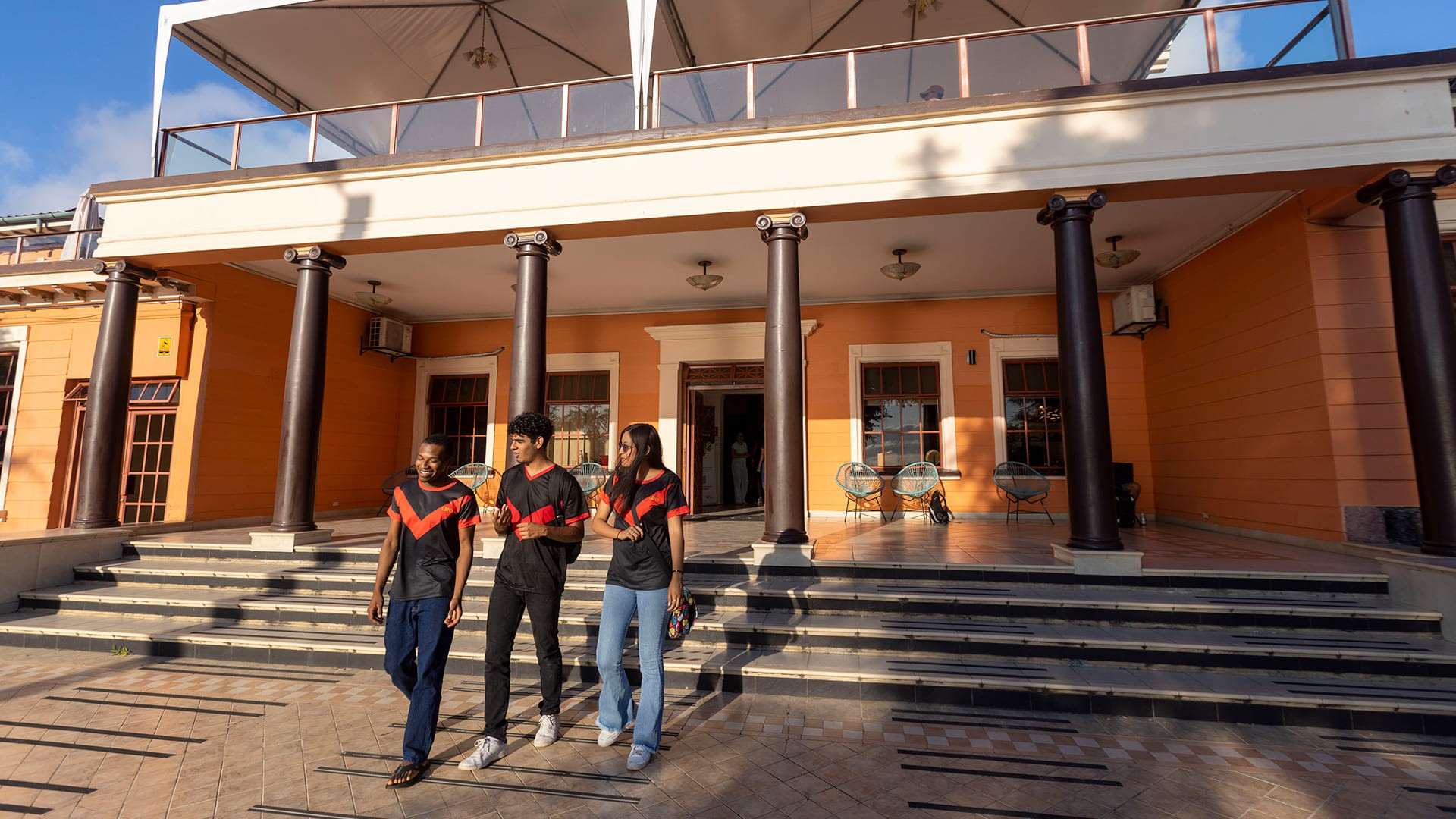
The campus was designed as a meeting space. A place where paths cross, conversations continue outside the classroom, and ideas appear where least expected.
Over time, the university discovered that curiosity does not fit in a single place. The experience expanded to the Tiputini Biodiversity Station, the Tandayapa Cloud Forest Station, the Galapagos Science Center (GSC), and GAIAS Europa: each setting reminds us that the world is a classroom.
Today, USFQ is the best positioned in Ecuador and ranks among the best in Latin America. The university changed in scale; the idea did not. Its purpose lives on in every student who walks through its doors and in a community that learns, creates, and transforms.
The values that build USFQ
Since its founding, USFQ was built around four principles that define its way of understanding education and university life: truth, goodness, beauty, and freedom.
Truth
Truth is sought, questioned, and built through the encounter of ideas. At USFQ, sciences dialogue with the humanities, arts with technology, and different perspectives coexist in a space where asking is just as important as answering.
Kindness
Goodness gives meaning to the path. Knowledge gains value when it contributes to the well-being of others. Santiago Gangotena, founder of USFQ, expressed it in a simpler way: "you have to be good people". Learning also means developing empathy, responsibility and awareness of our relationships with others.
Beauty
Beauty invites us to observe, imagine and discover possibilities where others do not see them. It is present in art and in nature, but also in an idea, a solution, a discovery or a conversation.
Freedom
Freedom is the principle that makes all others possible. It means thinking autonomously, questioning the established, defending one's own ideas and being willing to change them. USFQ understands that the purpose of education is to liberate people to live a full life.
A community where ideas meet
The Colegio General is the heart of Liberal Arts at USFQ.
Regardless of the chosen major, every student can cross the boundaries of their discipline and encounter other ways of understanding the world. Here, an engineer can discover new perspectives through art; a doctor can question themselves through philosophy; a journalist can better understand economics; and a scientist can explore gastronomy, history, or music.
The great challenges of the world require professionals capable of connecting knowledge, engaging in dialogue with other fields, and leading innovative solutions. That is the purpose of a Liberal Arts education: to shape creative, critical, curious, and free-thinking individuals.
Alumni Community that transcends borders
Dragons forever.
The Alumni community forms a global network of professionals, entrepreneurs, researchers, artists and leaders who keep the spirit of the Liberal Arts alive long after leaving the classroom.
What begins as a shared experience of learning, curiosity and discovery transforms into opportunities for collaboration, networking, mentorship and professional growth.
The journey does not end with a degree, that is just the beginning.