USFQ History
The construction of a university project
The history of Universidad San Francisco de Quito USFQ began with an idea that challenged traditional models of higher education in Ecuador. From the vision of its founders, Santiago Gangotena and Carlos Montufar, the Liberal Arts, individual freedom and the pursuit of knowledge shaped a university conceived to teach people to think, question, create and transform.
Discover the moments that turned that vision into a university community with impact inside and outside of Ecuador.
Timeline
An idea that challenged the established order
In 1972, while completing his doctoral studies in Physics in the United States, Santiago Gangotena began to imagine a different university for Ecuador, inspired by the philosophy of Liberal Arts and a model of comprehensive education.
Upon his return to the country, Santiago and Carlos gathered academics and business leaders to turn that vision into a project. Together they founded the Corporación de Promoción Universitaria (CPU) and designed the curriculum, the credit system, and the Honor Code. Thus was born a culture that questioned hierarchies and promoted more horizontal relationships between students and professors.
For seven years, the project faced successive rejections from the organizations responsible for authorizing its operation. The idea, however, continued moving forward.
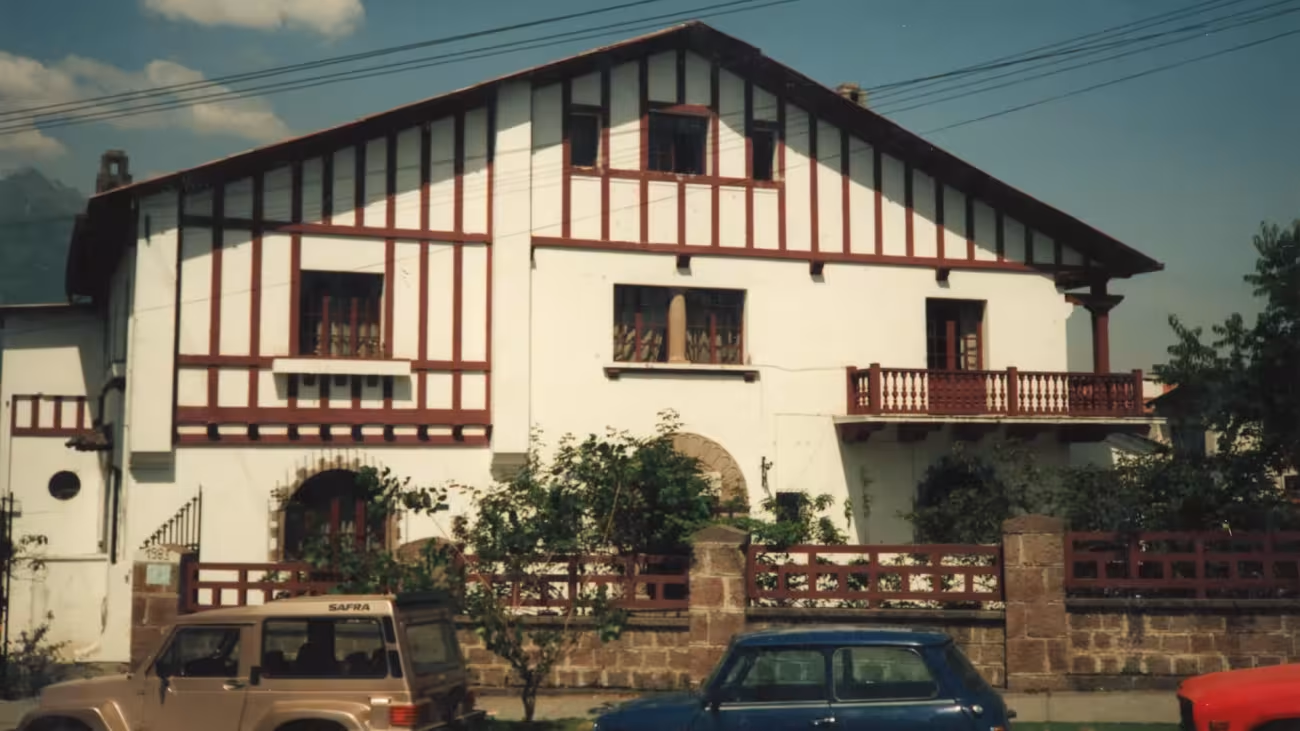
La Casita: the dream opens its doors
On September 1, 1988, USFQ began its activities in a house located on Avenida 12 de Octubre and Francisco Salazar. The first community consisted of 132 students and 9 full-time professors, in addition to part-time professors.
Resources were limited, but creativity defined those first years. The living room housed a library of approximately 6,500 titles; the kitchen served as a Physics and Chemistry laboratory; and the Computer Science professor had a closet on the second floor as his office. Professors, families, and collaborators contributed books, furniture, equipment, and work to make the new university possible.
A university open to the world
Faced with the lack of state recognition, USFQ sought new connections outside of Ecuador. In 1989, it signed its first recognition and academic exchange agreement with the University of North Carolina Wilmington. Agreements with the University of Illinois Urbana-Champaign and Kalamazoo College followed.
Thus, USFQ became the first international exchange university in Ecuador. By 1994, it already had around 36 exchange agreements that provided new academic opportunities for both national and international students.
Growing up also meant moving
Soon USFQ needed a larger space. After two years at the Casita de la 12 de Octubre, the university moved to Monteserrín in January 1991.
There it continued to expand its academic structure and created new colleges to accommodate 860 students. This growth made evident the need to build its own campus.
A campus for a new way of learning
In September 1994, USFQ moved to its new campus in Cumbayá with 1,480 students. The space was conceived so that the university experience would transcend the classroom and foster encounter, conversation, and community life.
Construction continued as classes began. Over time, gardens, plazas, works of art, and unexpected spaces gave the campus its own identity and turned it into a physical expression of the Liberal Arts philosophy.
Recognition and academic expansion
In October 1995, USFQ was officially recognized by the Ecuadorian State through Executive Decree 3166.
That period also marked an important academic expansion. The College of Jurisprudence was inaugurated and the creation of the College of Health Sciences was promoted. During that year, Professor Bruce Hoeneisen participated alongside hundreds of scientists in the discovery of the top quark at Fermilab, a reflection of a university that from its earliest years linked teaching with international scientific research.
From the Amazon to the Galápagos Islands
Research took USFQ far beyond the campus.
In the Ecuadorian Amazon, the Tiputini Biodiversity Station (TBS) was developed, conceived as a space for research and conservation in one of the most diverse ecosystems on the planet.
In 2002, the university expanded its scientific presence in the Galapagos Islands with the establishment of GAIAS in San Cristóbal —now the Galapagos Science Center (GSC)— to strengthen research and international academic collaboration from one of the most extraordinary natural laboratories in the world.
The dragon spirit
Around 2011, the founders incorporated two dragons into the institutional coat of arms. The choice had a history behind it: 1988, the year USFQ opened, corresponded to the Year of the Dragon in the Chinese calendar.
The dragon became a symbol of the USFQ community's identity and of a university philosophy linked, from its origins, with the freedom to create, think and build new paths.

A story that continues
What began in a small Casita on 12 de Octubre, became a university community built around the Liberal Arts, individual freedom and the permanent pursuit of knowledge.
The history of USFQ continues to be written through its students, professors, researchers, Alumni and those who find in the university a space to question the established, develop new ideas and transform their environment.