| |
ACADEMIC PROGRAMS
USFQ is a unique institution because it offers as many majors that are vocational (engineering, medicine, etc.) as are general (liberal arts, history, etc.) as part of the undergraduate program. USFQ believes with firm conviction that each student should receive one solid foundation in general culture and the arts.
Other than the General College program, USFQ guarantees to offer students fundamental courses such as composition, English, gastronomic culture, mathematics, physical education, internships, etc.
MAJOR
USFQ offers more than 50 majors as part of the undergraduate program, through which students are able to explore and develop their understanding within an academic environment.
Each major program is designed to reach from general to specific studies through a sequence of basic courses which can be obligatory or optional.

Higher-level courses normally aim to deepen the understanding of a specific area of study. Students are able to create a particular emphasis within a major by selecting their high-level courses.
In all areas, major programs develop skills in written and oral expression, thought and critical analysis, creative problem resolution and independent research.
Upon entering the university, each student has to clearly state his/her specific academic interest. At the beginning of the second year, or at the latest, by the end of the second year, during registration week, the student has to inform what his or her major will be to his/her mentor.
College majors require at least 70 credits in courses of their area within the four-year course of study, except for vocational majors. Given that the university’s objective is to form individuals who end up having a broad level of knowledge, the remaining credits are part of the general school, optional courses and/or a minor (see below).
If a student has changed his/her major in the second year to another major whose tuition is more expensive, that student is expected to cover all costs that were not cancelled in the first year of his/her original major.
Each student pursuing an academic degree needs to maintain an average of C or higher in specific courses of his/her major. Students cannot obtain a D in a class of their major.
DOUBLE MAJOR
Students have the opportunity to select up to two majors which do not need to belong obligatorily to the same school. Students pursuing a double major need to obtain an authorization from their respective deans and should notify the Registrar. Students have to inform that they desire to pursue a double major before graduation.

Students that have obtained a degree from USFQ can opt for a second degree.
They should consult with the Office of the Registrar in order to ascertain the valid regulations.
Students are not able to obtain a second degree in the same college in which they obtained the first, without written authorization from the academic dean.
Should this be the case, the students cannot have the financial advantages that other students do when taking only additional courses.
MINOR
USFQ offers a variety of minors.
Every student that is interested in acquiring a minor needs to complete between 15 and 21 credits with a C-average or higher, in accordance with specific requirements.
A student is able to obtain up to a maximum of 2 minors.
CONCENTRATION
Concentration is the amount of credits that a student takes within his/her major plus the additional specific credits in his/her study area.
CHANGING A MAJOR / SCHOOL
Students are able to change their college or major provided that they notify this change to the Office of the Registrar. The student should consider that changing a major, in general, will require that the student take additional courses throughout additional semesters, as well as added cost in certain studies (see financial information). In certain colleges, there exist other special academic requirements that students need to complete before opting for that major.
THE HONORS PROGRAM AT USFQ
The Honors Program at USFQ promotes interdisciplinary knowledge, academic excellence, and original research by outstanding students, within the spirit of an enterprising initiative in the tradition of the Liberal Arts program at USFQ. The objective is, certainly, to contribute to Ecuador’s development in a global context.
Founded in the first semester of 2006, the Honors Program provides academic opportunities to the most brilliant and motivated students to deepen their interests conduct original research and exert leadership in areas of training, in accordance with the enterprising mission of the university.
Students who enter USFQ with scholarships of excellence should consider participating in the Honors Program in their second or third semester, in which they will work with selected professors who would best support their interests and personal preferences. Students with excellent trajectory in academic colleges are also invited to participate.
PROGRAM OBJECTIVES
• Provide opportunities to excellent students to work in conjunction with their mentors
• Promote original research with an interdisciplinary focus
• Increase the level of academic excellence through assisted research
• Provide the best students at USFQ with a forum through which their work will be publicly recognized
• Add to the research activities of those professors taking part in the program
• Improve the opportunities of students that pursue studies abroad, with the option of academic scholarships for graduate-level programs.
HONORS THESIS
During their third and fourth years, Honors students will receive encouragement to take classes recommended by their mentors and they will choose a member of their academic school as a thesis adviser. To respect the interdisciplinary purpose of the program, the students can choose to work with various professors for their theses. The theses will be evaluated by an interdisciplinary team consisting of the thesis director and two members of other academic schools.
USFQ: Areas of Study
The University of San Francisco of Quito offers university level instruction to obtain titles as Bachelor of Arts (BA) and Bachelor of Sciences (BS) which are obtained in four years. Likewise, the school offers professional degrees in Medicine (Doctor in Medicine, six years), Architecture (Architect, five years), Jurisprudence (Lawyer, six years), Veterinary Medicine (Veterinarian, six years) and Engineering (Engineer, five years).
The curriculum is subject to constant revision, accommodating the advances in each field and demands of the market. The University reserves the right to carry out changes in the programs of study and regulations when it is deemed convenient for academic betterment, in accordance with the decisions of its board of directors.
GENERAL SCHOOL
The General School itself does not offer titles or majors. However, it is obligatory for every student, excluding their coursework, to take twelve free elective credits and forty three credits from the General School in the following areas:
Administration/Entrepreneurs (3 credits)
Art (3 credits)
Science (3 credits)
Social Science (6 credits, two courses)
Lectures/Forums (1 credit, CG or Colleges)
Composition (3 credits, refer to Academic College)
Computer Science (0 credits)
Gastronomic Culture (1 credit)
Sports (0 credits, completion of two semesters)
Economics (3 credits)
Humanities (LIT/FIL) (3 credits)
English (3 credits) Another class of the "e" extension (3 credits)
Mathematics (3 credits, according to major)
PASEM and PASEC (2 credits, 1 for each internship)
Socratic Seminars (9 credits, two classes that must be taken in the first year. “Being and Cosmos” can be taken between the second and fourth years)
NOTE: There are some exceptions, depending on each School. Consult with your dean or mentor.
Following are the careers and majors by each School (except Grad School, which is described in a separate catalog).
ADMINISTRATION FOR DEVELOPMENT
Undergraduate Major
Business Administration (*)
Economics
Finance (*)
Marketing (*)
(* indicates also offered by Virtual USFQ)
Grad Program
Technician Associate Degrees / Associate Degrees
Business Administration
Associate in Business Administration (Gaias)
AGRICULTURE, FOOD AND NUTRITION
Undergraduate Major
Agribusiness Engineering (4 years)
Agribusiness Engineer (5 years)
Food Engineering (4 years)
Food Engineering (5 years)
Human Nutrition (4 years)
Nutritionist (5 years)
Undergraduate Minor
Agriculture
Food
Human Nutrition
Technician Associate Degrees/ Associate Degrees
Sustainable Agriculture
ARCHITECTURE AND INTERIOR DESIGN
Undergraduate Degree/Architecture Major
Interior Design
Technician Associate Degrees / Associate Degrees
Interior Decoration
LIBERAL ARTS
Undergraduate Major
Liberal Arts
Education
International Relations
Psychology
Clinical Psychology (5 years)
Psychology and Human Resources (*) Virtual USFQ Exclusive
Undergraduate Minor
American Studies
Anthropology
Education
Political Sciences
Creative Writing
Latin-American Studies
Philosophy
History
Art History
English
Literature (in Spanish)
International Relations
Psychology
Sociology
Technician Associate Degrees / Associate Degrees
Preschool Education
Liberal Arts Degree (Only available at the Women’s College)
LIFE AND ENVIRONMENTAL SCIENCES
Undergraduate Major
Biology
Biotechnology (4 years)
Biotechnical Engineering (5 years)
Ecology and Management of Natural Resources with a specialization in:
Applied Ecology
Marine Ecology
Environmental Communication
Sustainable Tourism
Environmental Engineering (4 years)
Environmental Engineer (5 years)
Environmental Administration (Only available on Virtual-USFQ)
Undergraduate Minor
Biology
Biotechnology
Environmental Education
Environmental Management
Environmental Engineering
Microbiology
Sustainable Tourism
Technician Associate Degrees / Associate Degrees
Degree in Environmental Management (GAIAS)
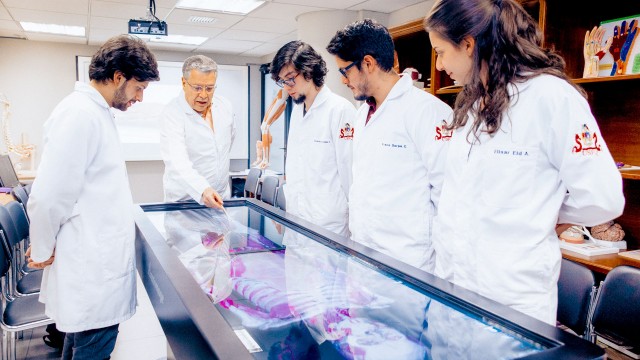
HEALTH SCIENCES
Undergraduate Major
Medicine
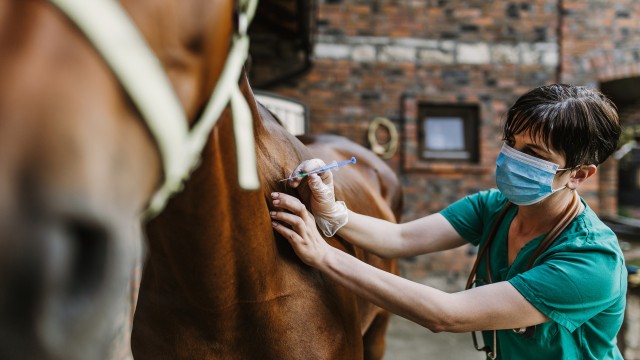
Veterinary Medicine
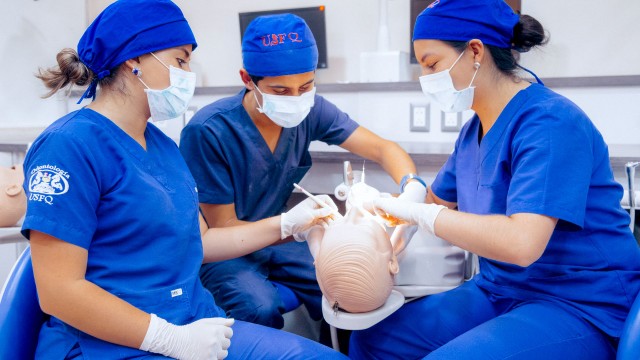
Dentistry
Optometry
ENGINEERING (Polytechnic School)
Undergraduate Major
Civil Engineering (4 years)
Civil Engineer (5 years)
Electrical Engineering and Electronic Engineering (4 years)
Electrical Engineer (5 years)
Industrial Engineering (4 years)
Industrial Engineer (5 years)
Mechanical Engineering (4 years)
Mechanical Engineer (5 years)
Chemical Engineering (4 years)
Chemical Engineer (5 years)
Systems Engineering (4 years)
Systems Engineer (5 years)
Physics
Mathematics
Chemistry
Aerospace Engineering
Undergraduate Minor
Civil Engineering
Civil Engineer with a minor in Transit
Electrical Engineering with a concentration in Control
Telecommunications
Industrial Engineering
Mechanical Engineering
Chemical Engineering
Systems Engineering
Physics
Mathematics
Chemistry
Applied Geology
Geographic Information System (Unigis)
POLICE SCIENCE
Undergraduate Major
Police Administration
COMMUNICATIONS AND CONTEMPORARY ART
Undergraduate Major
Multimedia and Journalism
Organizational Communications and Public Relations (*)
(*) Also available through Virtual-USFQ
Advertising Communication
Film & Video
Digital Animation
Interactivity & Multimedia
Communication Design
Contemporary Art
Undergraduate Minor
Multimedia and Journalism
Organizational Communications and Public Relations
Advertising Communication
Film & Video
Digital Animation
Interactivity & Multimedia
Communication Design
Contemporary Art
Photography
Performing Arts
Illustration & Sequential Art
Technician Associate Degrees / Associate Degrees
Public Relations
Graphic Design
Mass Media
Interior Design
Fashion Design
Public Relations
HOSPITALITY, CULINARY ART AND TOURISM
Undergraduate Major
Hospitality Business Management (*)
*also offered through Virtual USFQ
Hospitality Business Management (elective concentration: Tourism Business Management)
Culinary Art
Culinary Art and Food & Beverages Management
Undergraduate Minor
Hospitality
Technician Associate Degrees / Associate Degrees
Culinary Art
Tourism Operations
Tourism Business Technical Assistant (Gaias)
LAW
Undergraduate Major
Law
Undergraduate Minor
Human Rights
Environmental Law
Dispute, Negotiation, Mediation/Arbitration Procedures and Resolution
Technician Associate Degrees / Associate Degrees
Constitutional Law and Fundamental Rights (Police Students)
TECHNICIAN ASSOCIATE DEDREE
Undergraduate Major
(Transfer)
Management
Sustainable Agriculture
Graphic Design
Pre-school Education
Mass Media
Technician Associate Degrees / Associate Degrees
Business Management
Culinary Art
Sustainable Agriculture
Interior Design
Fashion Design
Graphic Design
Pre-school Education
Vehicle Electro mechanics
Mass Media
Tourism Operations
Public Relations
Tele-matics , Networks and Operational Systems
Business Management Technical Assistant
6B-14 Distance Education
Undergraduate Major
Business Management
Marketing
Finance
Hospitality Business Management
Organizational Communication and Public Relations
Environmental Management (Virtual USFQ only)
Psychology and Human Resources (Virtual USFQ only)
6B-15 Institute of Contemporary Music
(5) Undergraduate Major
Contemporary Music
Musical Production and Sound
DEPARTMENT OF GENERAL STUDIES (General School)
The USFQ defines General Studies as the process by which the students are motivated to learn and shape a healthy attitude about their studies and life. Moreover, the liberal arts program promotes an enterprising spirit amongst the students so that they can become leaders in the economic and social development of Ecuador.
1. Socratic Seminars
The foundations of the General Studies Program
The main aim of the Socratic seminars is to offer the students, in an interactive environment, the intellectual tools to get to know themselves and their surroundings through self-meditation and speech.
Each seminar should provoke thought, creativity, research, skill in critical thinking and a passion to continue their studies. The conversation and debates created in class motivate the student to take up an analytical and critical position concerning the ideas discussed.
Description of the Socratic Program:
CID101A The Being: Knowledge of One’s Self (3 credits)
In this course the student learns ways to get to know themselves by using certain classical methods from the Orient. In particular, they will cover Taoist, Buddhist and Hindi methods on how the mind and body work through the execution of relaxation, concentration and meditation exercises. Also they will be given an introduction to physical methods of relaxation such as Tai Chi or active meditation. This is not a course in religion or philosophy, but a course where the mind is used in a non-academic way, where students will learn to calm their minds and free themselves from conditioning influences and attachment. This is a course of introspection.
CID102 Cosmos: Investigation of the physical universe in which we live (3 credits)
The purpose of the Cosmos course is to awaken intellectual curiosity and fascination about science, and the relationship between the human being and the physical universe. This seminar encourages the understanding and analysis of scientific concepts and theories, applying them by means of research and experimentation. Cosmos is guided by questions, exploration of technological advances and the use of scientific methods.
CID103 The Being and The Universe: Latin America from a global perspective (3 credits)
The main objective of The Being and The Universe is to direct the students towards the analysis of Latin America and of Ecuador from a global perspective, based on the original intellectual contribution of this continent to western tradition. This course helps the students to become aware of their mixed race identity in a socio political context within the reality of the Latin American situation. This includes the reading of classical, American and contemporary texts.
CID104 Biosphere: The exploration of the biological setting of which we are a part (3 credits)
This course analyzes the biological phenomenon and the evolutionary process which brought into being the various forms of life which inhabit our planet. The students examine the dynamics of human beings, their biological identity and their evolutionary relationship with other species. They also explore environmental problems, the conflicts between different forms of life and the human activity inside the ecological panorama of Ecuador.
2. Art (3 credits)
In order to achieve a rapprochement and to develop a greater appreciation for the arts 3 credits are required in any of the following areas:
ART Art (Department of Communication and Contemporary Art)
DAN Dance (Department of Communication and Contemporary Art)
TEA Theatre (Department of Communication and Contemporary Art)
ACF Plastic arts (Department of Communication and Contemporary Art)
IMC Music (Institute of Contemporary Music)
3. Science (3 credits)
A science course of 3 credits offers the students a basic introduction to the following areas:
BIO Biology (Department of Biological and Environmental Sciences)
ECL Ecology (Department of Biological and Environmental Sciences)
FIS Physics (Department of Sciences and Engineering)
NUT Nutrition (Department of Agriculture, Food and Nutrition)
QUI Chemistry (Department of Sciences and Engineering)
These courses will include lab work or field trips to the countryside.
4. Social Sciences (6 credits)
The two social science courses (3 credits each) should be from the following areas:
ANT Anthropology (Department of Liberal Arts)
ARH Archaeology (Department of Liberal Arts)
HIS History (Department of Liberal Arts)
POL Politics (Department of Liberal Arts)
REL International Relations (Department of Liberal Arts)
RCL Resolution of Conflict and Leadership (Department of Liberal Arts)
SIC Psychology (Department of Liberal Arts)
SOC Sociology (Department of Liberal Arts)
The student will have to take one course of level 200/300 and another of level 300/400.
5. Composition (3 credits)
Each student will take an entrance exam to indicate which course in composition they should take.
According to the result of this exam the student will be able to skip certain levels, but it is mandatory to follow the guidelines of the course:
ESP210 Composition 2 (Department of Liberal Arts)
This course will help the student to improve their written expression which is necessary in every area of study.
Moreover, this course teaches the basis of written expression at the very beginning of college studies.
6. Lectures or Forums (1 credit)
The students must attend a series of lectures:
COL010 Lectures (Department of General Studies)
COL Forums offered by all the departments (*)
(*) We suggest that the students sign up for the forums offered in the different departments. The aim is to create a wide perspective of the current situation through presentations by experts and leaders of the country.
7. Gastronomic Culture (1 credit)
The course in Gastronomic Culture should be taken by the students for one semester after acquiring 30 credits.
GAC 100 Cultural Gastronomy (College of Hospitality, Culinary Art and Tourism)
8. Sports – Two Semesters (0 Credits)
Students should complete two semesters of sports:
DEP Sports (Two Semesters)
Students do not receive credit but sports are mandatory. The first course should be taken during the first year. Some sports do not take place on campus.
Description of sports:
DEP 111/112 SOCCER (Males/Females)
Technical preparation: taking the ball, reception, recovery, ball touch, dribbling. Tactics: interception, defense, attack. Physical: aerobic skills; power. Strategy and techniques used individually and in the team. Regulations, games and tournaments.
DEP121 FENCING
Weapons: Floret, sword. Salutation. On-guard position. Basic movements and positions: positions and fencing lines, ligaments, straight hits, attack and lunge. Stops and response. Circular stops, counter-response and compound offensive action. One, two, coupe, counterattack.
DEP131 TRACK
Tests in track and field. Warm-up and stretching. Training for speed. Relay races. Hurdles. Obstacles. Long distance races. Cross country. Hurling. Jumps. Biathlon. Triathlon. Physical conditioning. Competitions.
DEP132 SWIMMING
Teaching four styles of swimming: breast stroke, freestyle, back stroke and butterfly. Flotation and submersion. Recreational activities. Water polo. Competitions.
DEP133 DIVING
This course will comply with the System of Continuing Education of PADI (Professional Association of Diving Instructors) which includes one academic section, another section for confined waters (pools) and another section for open waters (trips to the ocean).
DEP135 CYCLING
Mountain biking, route biking, recreational activities, rides.
DEP137 TABLE TENNIS
How to use all body segments in order to construct a point to train students by employing a basic playing. To teach the rules and basic technical fundamentals.
DEP139 ADVANCED TABLE TENNIS
Training aimed to athletes with experience at a high school and university level, with the purpose of recruiting them for tournaments to represent the university at local, nation wide and international levels.
DEP143 BASKETBALL
Basic and specific fundamentals. Training in techniques and tactics. Ball handling, dribbling, shots. Offense and defense. Theory: symbols, testing, regulations and timing.
DEP153 VOLLEYBALL
Technical fundamentals: receive, pass, serve. Coordination for spikes, blocks, defense. How to develop skills to apply them to the most suitable system in order to shape game tactics for the team.
DEP160 AEROBICS
Cardiovascular exercise from low to high intensity. There are various types: low tone, gymnastics, circuit class, etc. Aerobics fight stress, prevent future injuries by strengthening muscles, toning muscle tissues, and producing endorphins.
DEP171 TENNIS
Mechanics of movements, correction and technique. Basic and advanced tennis in competitions. Doubles. Tournaments and games.
DEP175 TAE KWON-DO
Theoretical and practical classes, technique of combat attack, counterattack. Defense, kicks, videos and internal and external competitions at local levels.
DEP181 HATHA YOGA
Loosen and strengthen the body by utilizing complete breathing, rhythmic respiration. Posture. Meditation and relaxation. Theory and practice. Dynamic techniques.
DEP184 TAI-CHI
Strengthening the body, development of the mind and perfection of the spirit. Posture and breathing.
DEP195 MOUNTAIN TREKKING
Theoretical and practical classes of climbing rock, snow, and ice. Hikes to medium-height and high mountains.
DEP201 ADVENTURE SPORTS
Physical preparation in the gym: bike riding, pilate, customized training board. Mountain biking, trekking, rope systems, rappelling and safe knot tying techniques. Navigation classes (using maps, coordinates and compass); internal and external competitions.
9. Economics (3 Credits)
The course has 3 credits:
ECN 100 Economics (School of Administration for Development)
The class will teach the students the fundamental aspects of the economy in our country and in the world, and will analyze the current economic problems.
10. Entrepreneur or Administration (3 Credits)
The students should complete Entrepreneur or Administration (3-credit course):
EMP201 or EMP340 Entrepreneurs (School of Administration for Development) or ADM211 Administration (School of Administration for Development)
The course offers training in entrepreneurship for students in any career by teaching basic concepts and tools that will be useful for them at any company where they may eventually obtain a position to work.
11. Humanities (3 Credits)
The course has 3 credits:
LIT or FIL Literature or Philosophy (School of Liberal Arts)
The students must take a course in the field of Literature (LIT) or Philosophy (FIL)
12. English (3 credits)
The following is a 3-credit course:
ENG100 Composition and Rhetoric (English)
(School of Liberal Arts)
Upon starting the university studies, the students must take a placement test in order to be placed in the correct level of English as a Second Language (ESL). ESL is made up of 7 levels. The students must complete those 7 levels at the Institute of Foreign Languages (ILE) at the USFQ. Once they have fulfilled this requirement, they must take ENG100. Next, the students must take another 3-credit course taught in English. This course can belong to the same General School, to the Major, or to any other academic area. This course is named with the extension “e” (e.g.: ADM211e). Those students willing to continue with the English program after completing the courses mentioned above should refer to the Minor requisites and course description for complete information.
13. Mathematics (3 credits)
The students must complete a minimum of 3 credits in Mathematics:
MAT Mathematics level 100 or higher (School of Sciences and Engineering: Polytechnic School)
This requirement may vary depending on the major chosen.
The students should refer to this Catalog for descriptions on the chosen school and Major requirements.
14. Computer Science (0 credits)
Knowing how to use a computer is a requirement at the USFQ, and it is not part of the General School program.
In order to satisfy this requirement, the students must either pass a skills test during the first semester, or take a computer science course which can be part of their curriculum.
For example: CMP090 Computer Science (School of Sciences and Engineering: Polytechnic School)
CMP-090 Office Tools (0 credits)
Objective: To teach the students how to use an advanced level of Office. Nowadays, it is very important to develop skills by using Word Processors, Electronic Sheets, Multimedia Integrators, and Data Base. By mastering them, the users will attain high productivity in the office work.
Description: Microsoft Office Suite will be used to teach this course. Only original and genuine material will be used in order for the students to become officially certified as software specialists. The course focuses on advanced and integrated use applications in order to attain results at a professional level.
15. Internships (2 credits)
A. PAS101-PASECC (1 Credit)
Community service and cultural service
• It is mandatory that students do an internship in community service and cultural service. This internship consists of one Seminar and 100 work hours.
• As this activity progresses, the student gets involved in the reality of a community group which is different from that of the student. Therefore, he/she has the chance to help to solve problems that affect those human groups. The students also develop skills that lead to mutual understanding, respect and tolerance towards all the group’s members. Additionally, other skills, such as team work, are developed too. This requirement should be completed during the second year of studies.
• Internships do not pay a salary or allowances at all.
• A PASECC student bears the responsibility of representing all the USFQ community. Therefore, he/she should observe an appropriate behavior and should always abide by the Code of Honor of the USFQ.
B. PAS401-PASEM (1 credit)
Business Internship
• Each student should do at least one business internship at any private company or public institution, except if it is a family business or a USFQ company
• These internships are coordinated by the Department of Internships and should comply with the Law of Internships. Generally, these internships take place throughout the summer period between the third and fourth year.
• Upon completion of the internship, the students will have 6 months to turn in all the documentation related to the internship; otherwise, he/ she will have to register for one more semester in order to validate the internship.
Business Contact Event
This is an event that takes place at the USFQ campus in order to help students contact and start out the process of interviews with those companies that take part in the event. It is an event aimed at all of those who are studying their last year.
ELECTIVE SUBJECTS (12 credits)
Besides the General School subjects and their Major subjects, the USFQ students should take 12 credits in elective subjects throughout their study period.
Such subjects, which should at least be level 200, will be chosen by the student and can belong to any school, including their Major school.
The students can choose subjects that are not related to their major, as long as they comply with the pre-requisites. The main goal of taking these subjects is to encourage students to explore other areas beyond their Majo field, and to increase skills in different areas of knowledge within the USFQ Liberal Arts philosophy. These credits can be used as a basis to study a second major or to study a minor.
|
|